

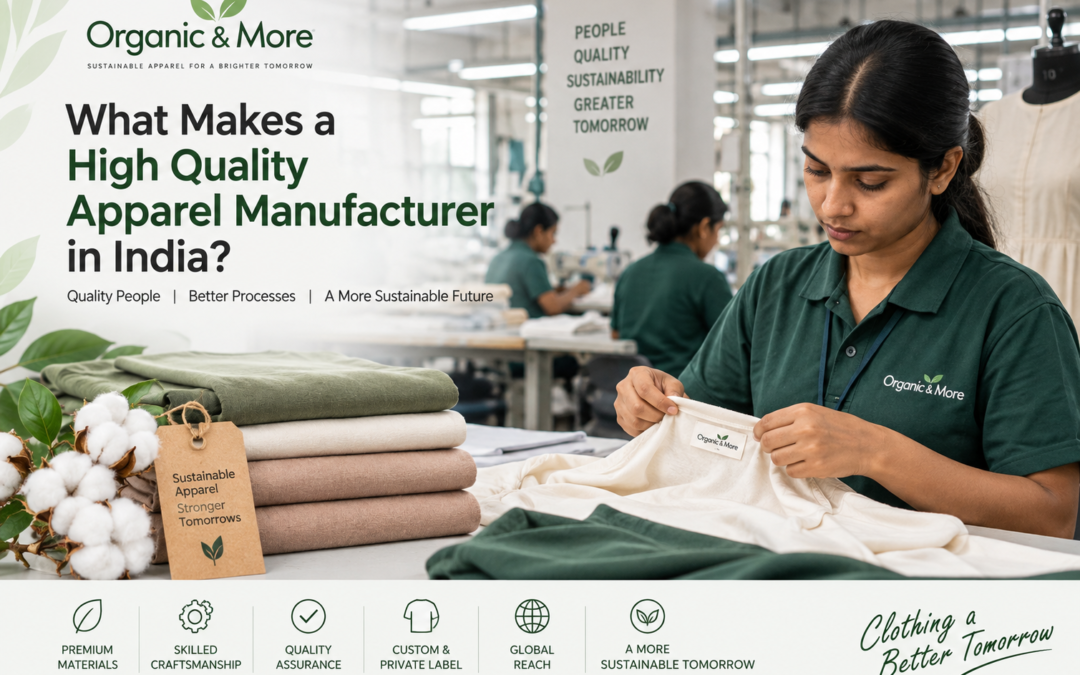
Finding the right apparel manufacturing partner is one of the most important decisions for any clothing brand. A good design can attract attention, but the final product is what customers actually experience. Fabric quality, fit, stitching, finishing, comfort, colour consistency and durability all depend heavily on how well a garment is manufactured.
This is why brands searching for a high quality apparel manufacturer India should look beyond attractive product photographs or low quotations. A dependable manufacturer needs to understand fabrics, product development, production planning, quality control, finishing, packaging and delivery as one connected process.
India has a long textile and garment-making tradition, supported by a wide variety of fabrics, skilled workers and established manufacturing clusters. However, every factory works differently. Selecting the right clothing manufacturer in India requires understanding what separates professional apparel production from basic garment stitching.
For brands that value quality, responsible manufacturing and long-term supplier relationships, the decision should be based on capability, transparency and consistency rather than price alone.
Organic & More is one example of an Indian manufacturer working in this space. Based in Noida, India, the company states that it has been involved in sustainable apparel manufacturing since 2005 and works with knitted and woven apparel, particularly organic cotton products. Its official information also lists certifications and compliance credentials including GOTS, STANDARD 100 by OEKO-TEX® and SEDEX-related approval or auditing.
So, what actually makes a high-quality apparel manufacturer? Let us look at the factors that matter most.
1. Quality Starts With Understanding the Fabric
A garment can only be as good as the materials used to make it.
Two T-shirts may look similar in an online photograph but feel completely different after a customer wears and washes them. Fabric composition, yarn quality, fabric weight, knitting or weaving structure, dyeing, finishing and shrinkage behaviour can all influence the final garment.
A professional garment manufacturer in India should therefore pay close attention to fabric selection before bulk production begins.
For example, a brand developing an everyday cotton T-shirt may need to consider fabric weight, softness, breathability and shrinkage. A children’s garment requires additional attention to comfort and fabric safety. Sportswear may require stretch, moisture management or other functional characteristics.
The manufacturer should understand the intended use of the product rather than simply source the cheapest available fabric.
Fabric inspection also matters. Problems such as shade variation, holes, stains, knitting defects, uneven dyeing or inconsistent fabric width can create major quality issues during production.
For companies working with organic or responsibly sourced materials, traceability becomes even more important. Organic & More states that it works with certified organic cotton and other sustainable materials as part of its manufacturing approach.
A premium apparel manufacturer India should therefore treat raw-material selection as the beginning of quality control, not as a purchasing exercise.
2. Product Development Comes Before Production
High-quality manufacturing does not begin when hundreds or thousands of garments are placed on a cutting table.
It begins much earlier.
Product development allows a brand and manufacturer to convert an idea into a garment that can be produced consistently.
A buyer may provide a tech pack, reference sample, sketch, measurement chart, colour standard or fabric requirement. The manufacturer’s job is to understand those instructions and translate them into a workable product.
Pattern development plays an important role here. A garment can use excellent fabric and still receive poor customer reviews if the fit is uncomfortable.
Measurements must therefore be carefully interpreted.
The sample stage gives both sides an opportunity to evaluate design, construction, fabric behaviour, trims, printing, embroidery, fit and finishing.
Changes are far easier to make during sampling than after bulk production has started.
This is particularly important when working with a custom clothing manufacturer India because custom products often involve brand-specific requirements that cannot simply be taken from an existing production style.
Organic & More describes services including pattern development, sampling, sourcing, cutting, packing, printing and embroidery, indicating an end-to-end approach to apparel development and manufacturing.
For a growing fashion label, this kind of product-development support can be as important as sewing capacity.
3. Consistency Is a True Measure of Quality
Making one excellent sample is relatively easy.
Making hundreds or thousands of pieces with the same measurements, stitching quality, colour and appearance is much more difficult.
That is where manufacturing discipline becomes visible.
A reliable bulk apparel manufacturer India must be able to reproduce an approved standard throughout the production run.
Imagine a brand orders 2,000 T-shirts. The first 100 pieces look perfect, but later units have different neck shapes, inconsistent measurements or stitching problems. From the customer’s point of view, the brand—not the factory—will be held responsible.
Consistency protects brand reputation.
Production teams therefore need clear specifications, approved samples and repeatable procedures. Garment measurements should remain within agreed tolerances. Stitching should follow the specified construction. Accessories and trims should match approvals. Print placement should be controlled. Colours should remain consistent within acceptable standards.
Quality manufacturing is not about producing occasional perfect pieces. It is about creating a system that makes consistent quality the normal result.
4. Quality Control Must Happen Throughout Production
Quality inspection only at the end of production is often too late.
Suppose 5,000 garments have already been stitched before a measurement problem is discovered. Correcting the issue could be expensive, slow or impossible.
Professional manufacturing therefore uses quality checks at different stages.
Raw materials can be checked when they arrive. Cutting can be inspected before sewing. Production teams can monitor stitching and measurements during assembly. Finished garments can then be reviewed before packing and shipment.
Organic & More states that its quality-control approach begins with raw-material sourcing and continues through the finished garment stage. Its quality information also says the company considers characteristics such as performance, reliability, conformance, durability and aesthetics.
This type of process-based thinking is important when choosing an apparel supplier in India.
Final inspection is still important, but it should confirm that the production process worked correctly rather than become the first time quality is examined.
5. Skilled Workmanship Still Matters
Technology has transformed apparel manufacturing, but garment making remains highly dependent on skilled people.
Operators need experience to handle different fabrics correctly. Lightweight knitwear behaves differently from structured woven fabric. Stretch fabrics require different handling from non-stretch fabrics. Delicate children’s apparel may require careful seam construction and finishing.
Experienced pattern makers, sampling teams, machine operators, finishing teams, merchandisers and quality inspectors all contribute to the final product.
Small details can reveal manufacturing quality immediately.
Look at whether seams are clean and balanced. Examine the inside of the garment as carefully as the outside. Check whether loose threads are removed. Observe whether collars sit correctly. Look at pocket alignment, zipper installation, button placement, hems and label attachment.
Customers may not know the technical terminology behind these details, but they can often recognise when a garment feels well made.
That is why workmanship remains an essential characteristic of any high quality apparel manufacturer India.
6. Communication Can Make or Break a Manufacturing Relationship
Apparel production involves constant communication.
A buyer may need updates about sampling, fabric availability, approval timelines, production status, packaging or dispatch.
Poor communication creates uncertainty and can cause expensive mistakes.
A professional manufacturer should clearly communicate what information is required before production starts. If a design cannot be manufactured exactly as requested, the factory should explain the problem early and suggest practical alternatives.
The same applies to lead times.
Promising an unrealistic delivery date may help win an order, but it rarely creates a successful long-term relationship.
Good communication means setting practical expectations and informing the customer when a decision is required.
For international brands working with an apparel exporter India, communication becomes even more important because buyers may be managing product development from another country and time zone.
A capable merchandising team often acts as the connection between the buyer and different departments inside the factory.
7. Private Label Manufacturing Requires Brand Understanding
Private label manufacturing is more than attaching a client’s logo to a standard garment.
A successful private label product should reflect the identity of the brand selling it.
That may involve specific fabrics, colours, measurements, silhouettes, labels, packaging, trims, printing, embroidery or other details.
A capable private label apparel manufacturer India should therefore understand that different clients have different markets.
A premium children’s label may prioritise softness, fabric safety and delicate styling. A casual fashion brand may focus more heavily on fit and washes. An eco-conscious company may place stronger requirements on material certification and supply-chain documentation.
Organic & More describes itself as providing private label production for knitted and woven ready-to-wear garments and states that it works with brands and retailers in international markets.
For brands developing their own identity, the ability to customise responsibly is an important manufacturing advantage.
8. Responsible Manufacturing Is Becoming More Important
Price and quality remain important, but modern apparel buyers increasingly look at how products are made as well as what they look like.
Responsible manufacturing can include environmental practices, worker conditions, material sourcing, chemical management, waste reduction and traceability.
Certifications can help buyers evaluate some of these areas, although brands should always confirm which certification applies to the specific factory, material or product they intend to source.
Organic & More states that it is GOTS certified, STANDARD 100 by OEKO-TEX® certified and associated with SEDEX compliance or auditing. Its website also describes a long-term focus on organic cotton and responsible manufacturing.
These considerations are particularly relevant for children’s and baby clothing, where buyers may have stricter expectations around materials and product safety.
For brands seeking a high quality garment supplier India, responsible production can therefore be part of quality rather than a completely separate subject.
A beautifully stitched product loses some of its value if the supply chain behind it does not meet the expectations of the market where it will be sold.
9. Manufacturing Capacity Must Match the Buyer’s Needs
A large factory is not automatically a better factory.
The important question is whether the manufacturer’s capacity and production system are appropriate for the buyer.
Smaller fashion companies may value flexibility, development support and manageable minimum order requirements. Larger retailers may place more emphasis on production capacity, repeatability and reliable bulk delivery.
Before selecting a clothing manufacturing company India, buyers should discuss expected order quantities, product categories, number of styles, colourways and delivery schedules.
Capacity is especially important when a brand begins to grow.
A supplier that performs well on an initial order should ideally have the systems needed to support larger repeat orders without sacrificing consistency.
Organic & More’s product-quality page currently states a daily manufacturing capacity of approximately 3,500–4,000 units for its baby apparel facility.
Capacity figures, however, should always be considered alongside product complexity and current production schedules. Five thousand simple T-shirts and five thousand highly detailed garments do not require the same amount of production time.
10. Finishing and Packaging Are Part of Product Quality
Manufacturing does not end when sewing finishes.
Garments still need to be checked, cleaned of loose threads, pressed or finished as appropriate, folded and prepared for packing.
The presentation of the final product matters, especially for private labels and retailers.
A garment arriving in good condition reduces unnecessary handling at the buyer’s warehouse and creates a better retail experience.
Labels, barcodes, size stickers, hangtags, cartons and other packaging requirements may also differ between customers.
For export orders, packing accuracy can become operationally important. Incorrect assortment quantities or carton markings can create problems even when the garments themselves are perfect.
A professional garment supplier in India therefore pays attention to both the product and how the product leaves the factory.
11. Export Experience Adds Another Layer of Capability
Manufacturing garments for the domestic market and supplying international customers can involve different requirements.
Export-focused manufacturers may need to work with detailed specifications, buyer-specific packaging, documentation, shipping schedules and destination-market expectations.
Organic & More states that it is based in Noida and exports garments internationally, with customer relationships across regions including North America, Europe, the UK, Australia and New Zealand.
When choosing a clothing exporter from India or apparel exporter India, buyers should look beyond whether a company has shipped internationally before.
The more important questions concern how the manufacturer manages specifications, approvals, timelines, documentation, communication and quality expectations for overseas customers.
International experience can be valuable, but disciplined processes remain the foundation.
12. Flexibility Helps Brands Develop Better Products
Fashion is rarely completely predictable.
A brand may begin with one design and make changes after reviewing the sample. A certain fabric may become unavailable. Customer feedback may lead to adjustments in fit. A new colour may suddenly become commercially important.
Manufacturers need enough flexibility to handle reasonable changes without losing control of the production process.
This is particularly valuable for startups and independent brands.
A custom clothing manufacturer India that understands product development can often help a client identify manufacturing challenges before those challenges become expensive.
That does not mean every requested change can be made at every stage. Once fabric has been purchased and bulk production has begun, changes may have cost and timing consequences.
Good manufacturers explain those consequences clearly.
13. Price Should Be Evaluated Together With Value
Cost is understandably important.
Every apparel business needs sufficient margin to remain profitable. However, the lowest manufacturing quotation does not always create the lowest final cost.
Poor-quality products can generate returns, customer complaints, rework, cancelled orders and reputational damage. Late delivery can cause missed selling seasons. Inconsistent sizing can reduce repeat purchases.
A slightly higher production cost may therefore make business sense when it provides better materials, dependable construction and stronger quality control.
When buyers search online for the best apparel manufacturer in India, it is better to define “best” according to the needs of the brand rather than looking for one factory that supposedly suits everyone.
A premium babywear brand, a fast-fashion retailer and an activewear startup could each require very different manufacturing partners.
Quality is ultimately about suitability and consistency.
14. Transparency Builds Long-Term Partnerships
Strong manufacturer-brand relationships are built over time.
Transparency makes that possible.
A reliable manufacturer should be clear about capabilities, production limitations, minimum quantities, lead times, material availability and pricing.
Buyers should be equally clear about quality expectations, design specifications, target quantities and approval schedules.
Problems can happen in any manufacturing process. What often distinguishes reliable suppliers is how quickly they identify problems and how responsibly they respond.
A manufacturer that communicates openly when something goes wrong can be far more valuable than one that simply says yes to every request.
Long-term partnerships allow both parties to understand each other’s systems, which can improve product development and reduce mistakes over future seasons.
15. Where Organic & More Fits Into High-Quality Apparel Manufacturing
For brands specifically searching for a high quality apparel manufacturer India, Organic & More provides an established example of an Indian manufacturer focused on organic and sustainably positioned apparel.
The company is a registered brand of Net Paradigm India Pvt. Ltd. and states that it has been involved in apparel manufacturing since 2005. Its manufacturing portfolio includes apparel for infants, toddlers, children, young adults and women, using both knitted and woven fabrics. Its website also lists products such as maternity-related apparel, soft toys, sweaters and baby bedding alongside its garment categories.
Organic & More also describes private label and custom manufacturing services extending from sourcing and product development to sampling, production, finishing and shipment.
For companies interested in organic cotton apparel, these capabilities can be relevant when evaluating potential manufacturing partners.
As with any supplier relationship, brands should discuss their exact style requirements, quantities, certification requirements, timeline and commercial expectations directly before placing an order.
How Should a Brand Choose an Apparel Manufacturer in India?
The selection process should begin with the product.
First determine exactly what you intend to manufacture. Understand the fabric, target customer, price position, expected quantities and quality level.
Then evaluate whether the supplier has relevant experience.
A manufacturer that specialises in one category may be more suitable than a general factory, depending on the product.
Ask for clarity about sampling and development. Understand how approvals are managed. Discuss expected tolerances and quality standards before production begins.
If certifications matter to your business, verify them and determine whether they cover the specific materials and processes you require.
Discuss packaging, inspection, production timelines and shipping requirements as well.
Most importantly, evaluate communication during the development stage. Sampling often provides an early indication of what a future production relationship may look like.
Whether you need a wholesale garment manufacturer India, a private label partner or a specialist organic apparel supplier, careful evaluation before the first bulk order can save considerable time and expense later.
What Makes a Manufacturer “High Quality”?
There is no single machine, certification or marketing statement that automatically turns a factory into a high-quality manufacturer.
Quality comes from a combination of factors.
It comes from selecting suitable raw materials.
It comes from accurate patterns and carefully approved samples.
It comes from trained operators who understand garment construction.
It comes from checking quality while production is happening instead of waiting until the end.
It comes from maintaining measurements and construction standards across hundreds or thousands of pieces.
It comes from honest communication.
It comes from finishing garments properly and delivering them according to agreed specifications.
And increasingly, it also comes from understanding the environmental, social and traceability expectations of modern apparel businesses.
This is the difference between simply manufacturing clothing and building a reliable apparel supply chain.
Final Thoughts
India offers brands access to a deep textile and garment manufacturing ecosystem, but choosing a supplier should never be based only on location or price.
A dependable high quality apparel manufacturer India combines material knowledge, product-development expertise, skilled workmanship, quality control, consistency, communication and responsible business practices.
Businesses searching for a premium apparel manufacturer India, apparel supplier in India, private label apparel manufacturer India or clothing manufacturing company India should therefore look closely at the entire manufacturing process.
The right manufacturer should understand that every garment carries the reputation of the brand whose name appears on the label.
For companies interested in organic and responsibly manufactured apparel, Organic & More represents an Indian manufacturing option with operations dating back to 2005, organic cotton experience, private label capabilities and documented certification information available through its official channels.
The goal should not simply be to find a factory capable of making clothing.
The goal should be to build a manufacturing relationship capable of producing products customers will be comfortable buying, wearing and returning to again.
That combination of product quality, consistency, transparency and manufacturing discipline is what truly defines a high-quality apparel manufacturer in India.
Frequently Asked Questions
What should I look for in a high quality apparel manufacturer in India?
Look at the manufacturer’s fabric knowledge, sampling process, production capabilities, workmanship, quality-control procedures, communication, certifications where relevant, finishing standards and ability to meet agreed delivery requirements. The right supplier should also have experience with the type of garments you plan to manufacture.
Why do international brands source garments from India?
India has a broad textile and apparel ecosystem with access to different fabrics, manufacturing techniques and skilled garment workers. Buyers should still evaluate individual factories carefully because capabilities and specialisations vary considerably between manufacturers.
What is a private label apparel manufacturer?
A private label manufacturer produces garments that are sold under another company’s brand. Depending on the arrangement, services may include fabric sourcing, pattern development, sampling, custom measurements, printing, embroidery, labels, packaging and bulk manufacturing.
Can Organic & More manufacture organic cotton clothing?
According to its official website, Organic & More specialises in organic cotton apparel manufacturing and states that it works with GOTS-certified organic cotton and sustainable materials. Buyers requiring a specific certification or transaction-level documentation should confirm the applicable certification details directly for their order.
Where is Organic & More located?
Organic & More states that its manufacturing operation is based in Noida, Uttar Pradesh, India, and that it supplies customers in multiple international markets.
Is Organic & More suitable for private label clothing?
Organic & More’s official website describes end-to-end private label clothing manufacturing services for woven and knitted apparel, including sourcing, development, production and related manufacturing support.
Recent Comments